




Short answer:
CAR T-cell therapy can produce very long, sometimes curative-like remissions in certain leukemias — especially relapsed/refractory B-cell ALL — but it does not reliably cure every patient, and relapse still occurs. That’s why doctors usually speak about remission, not guaranteed cure.
Cure vs. Remission
-
Remission = little to no detectable cancer.
Complete remission means no evidence of disease on current tests, but relapse remains possible.
-
Cure = no signs of cancer for many years and an extremely low likelihood of it ever returning.
With CAR T, many patients achieve remission. A subset experience very long-term remission that may be considered a functional cure — but cautiously.
What Is CAR T-Cell Therapy?
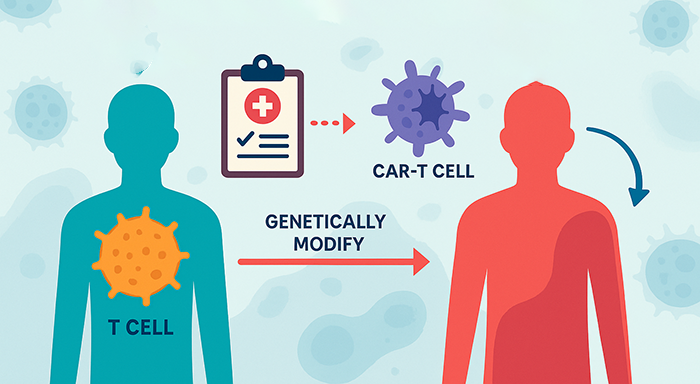
CAR T (Chimeric Antigen Receptor T-cell therapy) is a personalized immunotherapy:
- A patient’s T cells are collected.
- They are genetically engineered to recognize a leukemia marker (often CD19 in B-cell leukemias).
- The cells are expanded in the lab.
- They are reinfused to attack the cancer.
Approved commercial products targeting CD19 include Kymriah and Tecartus.
What CAR T Can Achieve in Different Leukemias:
B-Cell Acute Lymphoblastic Leukemia (B-ALL)
This is where CAR T has been most dramatic.
- In pediatric and young adult relapsed/refractory B-ALL, CD19 CAR T (tisagenlecleucel) induces remission in about 80% of patients in trials.
- Many had failed chemotherapy before CAR T.
- Some patients remain leukemia-free for many years.
In this setting, CAR T can absolutely clear disease — and in a proportion of patients, long-term remission may be functionally equivalent to cure.
Chronic Lymphocytic Leukemia (CLL)
CLL results are more variable.
- Early CAR T patients have shown CAR T cells persisting for 10+ years with ongoing complete remission.
- This demonstrates that extremely durable control — close to curative — is possible in some individuals.
- Registry and cohort data describe “very long remissions” especially in patients who remain progression-free at 1 year.
However, doctors still describe this as durable remission, not guaranteed cure for everyone.
Acute Myeloid Leukemia (AML)
CAR T for AML is still experimental. Why?
- AML targets overlap with healthy bone marrow cells.
- Targeting them risks damaging normal blood production.
Research is ongoing, but AML is not yet a reliable curative setting for CAR T.
How Often Is CAR T Truly “Curative”?
Although lymphoma is not leukemia, it uses the same CD19 CAR concept and gives insight into long-term durability.
In aggressive B-cell lymphomas:
- About 40% of patients may be effectively cured at 7-year follow-up.
- Around two-thirds achieve complete remission initially.
- Roughly half remain relapse-free at 1 year.
This shows that deep responses can translate into long-term disease-free survival — but relapse still affects a significant fraction.
For leukemia, the pattern is similar:
- High initial remission rates
- A subset with long-term disease-free survival
- But not universal cure
Why CAR T Doesn’t Cure Everyone
Several biological reasons:
- Antigen Escape
Leukemia cells may lose the target (e.g., become CD19-negative), leading to relapse. - CAR T-Cell Quality & Persistence
Not all patients’ engineered T cells persist long term. High exhaustion markers such as: LAG-3, TIM-3 are associated with lower response rates and earlier relapse. - Tumor Biology
Some leukemias have resistant subclones that survive initial treatment.
IMPORTANT:
Do not guess whether your disease can be treated with CAR-T therapy. Eligibility depends on many factors — and these criteria continue to evolve as research advances. Submit your medical documents to us for review. A senior hematology doctor will carefully assess your case, and we will provide an answer that reflects the most accurate medical guidance available today.
Initiating Your Medical Inquiry >>
Publication date: Feb 26, 2026.
Sources:
The journey to CAR T cell therapy: the pediatric and young adult experience with relapsed or refractory B-ALL
Remission vs. Cure in Cancer: What’s the Difference?
Study reveals new details about decade-long persistence of personalized ‘living drug’ cells
Early Relapsed DLBCL Outcomes Have Changed Drastically Due to CAR T
Treatment strategies for relapse after CAR T-cell therapy in B cell lymphoma
Study reveals new details about decade-long persistence of personalized ‘living drug’ cells