




If CAR T-cell therapy does not work, or if the cancer returns after an initial response, further treatment may still be possible.
Options can include bispecific antibodies, another CAR-T treatment, targeted therapies, antibody-drug conjugates, chemotherapy, radiation therapy or stem cell transplantation. The relevant options differ significantly between multiple myeloma, lymphoma and leukemia.
The next step depends on why the treatment failed, how long the response lasted, whether the original target protein is still present on the cancer cells, which treatments the patient has already received and the patient’s current medical condition.
Did CAR-T fail, or did the cancer return later?
Doctors generally distinguish between two situations:
Primary resistance means that the cancer did not respond sufficiently to CAR T-cell therapy.
Relapse after CAR-T means that the patient initially responded, but the cancer later returned.
This distinction is important. A relapse after a long remission may be approached differently from disease that progressed shortly after treatment or did not respond at all.
Before recommending another treatment, doctors may examine:
- How well the patient responded to the first CAR-T treatment
- How long the response lasted
- Whether the original CAR-T target is still present on the cancer cells
- Whether the cancer has changed or escaped recognition by the CAR T cells
- The treatments received before and after CAR-T
- The patient’s blood counts, organ function and general condition
- Whether another cellular therapy or clinical trial may be available
A new biopsy, bone marrow examination, imaging or laboratory testing may be required.
Why can CAR T-cell therapy stop working?
CAR-T treatment can fail for several reasons. The infused CAR T cells may not expand sufficiently, may lose activity or may not remain in the body long enough.
In other cases, the cancer cells reduce or lose the protein that the CAR T cells were designed to recognize. This is known as antigen loss or antigen escape.
The cancer and its surrounding environment may also suppress the immune response. In heavily pretreated patients, the condition of the patient’s T cells can affect the quality and persistence of the manufactured CAR-T product.
More than one mechanism may be involved. This is why the next treatment must be selected individually rather than solely on the basis that the previous CAR-T treatment failed.
What happens if CAR-T fails in multiple myeloma?
Most current CAR T-cell treatments for multiple myeloma target BCMA, a protein found on malignant plasma cells.
If myeloma progresses after BCMA-directed CAR-T, the treating team will consider how long the previous response lasted, whether the disease still expresses BCMA and which other myeloma treatments the patient has already received.
Possible approaches include:
Bispecific antibodies
Bispecific antibodies connect the patient’s T cells to myeloma cells. Depending on the product, they may target BCMA or a different myeloma-associated protein, such as GPRC5D.
After a BCMA-directed CAR-T treatment has failed, a therapy directed against a different target may be considered. Previous exposure to a particular target can affect the choice and sequence of subsequent treatments.
CAR-T directed against another myeloma target
Researchers are developing CAR T-cell therapies that recognize proteins other than BCMA. These treatments may potentially provide another option when myeloma does not respond to BCMA-directed CAR-T or returns after treatment.
According to information provided directly to Israeli Hospitals, Hadassah Medical Center is developing a CAR T-cell treatment for multiple myeloma that targets a different myeloma-associated protein. It is intended for patients whose first CAR-T treatment did not work or whose disease later relapsed.
The program is planned to become available during 2027. It remains under development and is not currently available. Its launch, eligibility criteria and timing will depend on completion of the development process and the required medical and regulatory approvals.
A second CAR T-cell treatment
A second CAR-T treatment may be considered in selected cases, particularly as part of a clinical trial. It may involve another product directed against the same target or a treatment aimed at a different protein.
Repeating CAR-T is not automatically suitable. Doctors must consider why the first treatment failed, whether the target is still present and whether adequate T cells can be collected and manufactured.
Other myeloma treatments
Other possibilities may include combinations involving immunomodulatory drugs, proteasome inhibitors, monoclonal antibodies, antibody-drug conjugates or newer agents.
There is currently no single standard treatment pathway after CAR-T failure in multiple myeloma. The decision depends on previous target exposure, disease characteristics, the duration of the CAR-T response and the treatments available to the individual patient.
What happens if CAR-T fails in lymphoma?
Most CAR T-cell therapies used for B-cell lymphomas target CD19.
If the lymphoma returns, doctors may test whether CD19 is still present on the cancer cells. A CD19-positive relapse differs from one in which the lymphoma has lost the target.
Possible treatments include:
- Bispecific antibodies: CD20×CD3 bispecific antibodies direct the patient’s T cells against lymphoma cells through a target other than CD19. They have become an important option for some patients with relapsed large B-cell or follicular lymphoma, including patients previously treated with CAR-T.
- Targeted or antibody-based treatments: Depending on the lymphoma subtype, these may include antibody-drug conjugates, targeted drugs or combinations with chemotherapy and immunotherapy.
- Radiation therapy: Localized radiation may sometimes be used to control a particular site of disease or as a bridge to another treatment.
- Another cellular therapy or clinical trial: Selected patients may be evaluated for a second CAR-T infusion, a product directed against another target or another investigational cellular treatment.
- Stem cell transplantation: Allogeneic stem cell transplantation may be considered for carefully selected patients who respond to treatment after CAR-T and are medically suitable for transplantation.
Relapse after CD19-directed CAR-T remains a serious clinical challenge, but the number of potential treatment options is increasing.
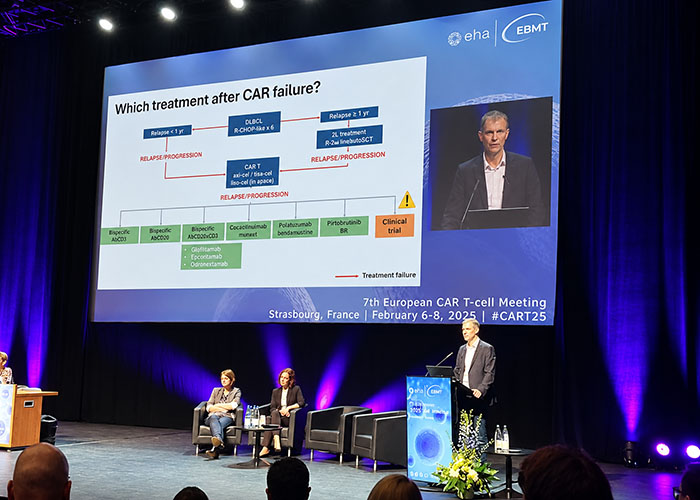
Photo: European Hematology conference CART25 in Strasbourg, France
What happens if CAR-T fails in B-cell acute lymphoblastic leukemia?
Relapse after CD19-directed CAR-T for B-cell acute lymphoblastic leukemia can occur with either CD19-positive or CD19-negative disease.
If CD19 remains present, another CD19-directed treatment may be considered in selected cases. If the leukemia has lost CD19, doctors may consider a therapy directed against another target, such as CD22.
Possible approaches may include blinatumomab, inotuzumab ozogamicin, investigational CD22-directed or dual-target CAR-T products and, for selected patients who achieve another remission, allogeneic stem cell transplantation.
The appropriate option depends on the patient’s age, previous treatments, previous transplantation, the leukemia’s current characteristics and the patient’s overall health.
Can bispecific antibodies be used after CAR-T?
Bispecific antibodies are among the most important treatment options being studied and used after CAR-T failure.
Unlike CAR-T therapy, they are manufactured in advance and do not require the collection and individual engineering of the patient’s T cells. However, they still activate the immune system and may cause significant side effects, including cytokine release syndrome, infections, low blood counts and neurological complications.
In multiple myeloma, doctors may consider whether to use a BCMA-directed or GPRC5D-directed treatment. In lymphoma, CD20-directed bispecific antibodies offer a treatment route that differs from CD19-directed CAR-T.
The choice between a bispecific antibody, another CAR-T treatment and another form of therapy depends on the disease, previous target exposure, the urgency of treatment and the patient’s medical condition.
Request an individual review
We assist international patients seeking evaluation for CAR-T and other advanced treatments in Israel.
Submit medical records for an individual CAR-T review >>
Updated: September 2026
Sources
- Min C, et al. “Strategies for salvage therapy post CAR-T therapy failure in refractory/relapsed multiple myeloma.” 2025. View source
- Rejeski K, et al. “Mechanisms of resistance and treatment of relapse after CAR T-cell therapy for large B-cell lymphoma and multiple myeloma.” Transplantation and Cellular Therapy. View source
- Asherie N, et al. “Development and manufacture of novel locally produced anti-BCMA CAR T cells for the treatment of relapsed/refractory multiple myeloma: results from a phase I clinical trial.” Haematologica. View source